Click Cash is Coming: Europe's Digital Currency Accelerates

While digital currencies often feel like abstractions reserved for tomorrow, the European Central Bank just made a move that demands attention today. The Governing Council has officially advanced the digital euro project into its next and final phase of preparation, signaling an acceleration that transforms long-term aspiration into immediate reality. Yet the significance of this announcement extends far beyond mere scheduling. It reveals the fundamental philosophy that will shape how Europeans interact with money in the coming years.
The timeline is no longer theoretical. Following the European Council's explicit request on October 23rd to accelerate the entire process, a concrete path has emerged. The European Parliament could grant approval as early as 2026. By 2027, a pilot program might already be running across select European markets. If that pilot succeeds, a full rollout spanning the entire Union could materialize by 2029. These are not aspirational targets floating in policy documents. They represent commitments that require businesses, financial institutions, and citizens to begin preparing now for a fundamentally different monetary landscape.
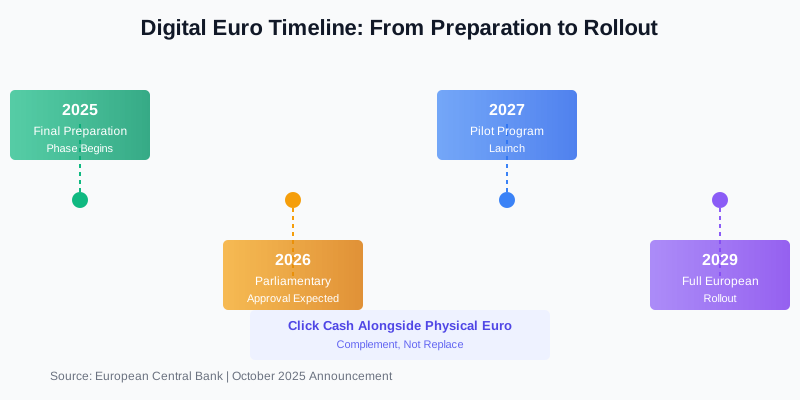
This compressed schedule carries weight precisely because it forces a shift from abstract discussion to practical planning. Financial institutions must consider how digital wallets will integrate with existing infrastructure. Retailers need to understand how point-of-sale systems will accommodate digital transactions alongside traditional ones. Regulators face the challenge of crafting frameworks that protect consumers while enabling innovation. The digital euro has crossed the threshold from concept to operational imperative.
Yet perhaps the most revealing element of the ECB's announcement addresses the concern that has dominated public discourse since digital currencies first entered mainstream conversation. The fear that physical cash would disappear, that tangible banknotes would become relics, has haunted every discussion of central bank digital currencies. The ECB confronts this anxiety directly by reframing the entire project. The digital euro is not a replacement. It is an expansion.
The language matters here. ECB officials describe wanting "cash to be in the form of digital euro as well, so that you can circulate banknotes and click cash with the digital euro." This phrase, "click cash," captures something essential about the vision. Physical euros will continue flowing through economies, exchanged in markets and tucked into wallets. Digital euros will exist alongside them, offering the same fundamental attributes of cash—direct peer-to-peer transfer, immediate settlement, no intermediary fees—but in digital form. The goal is not elimination but evolution, ensuring the euro remains practical and accessible as commerce increasingly moves online.
This complementary approach reveals a sophisticated understanding of how trust works in monetary systems. Cash represents more than convenience. It embodies autonomy, privacy, and the tangible certainty of value held directly rather than mediated through institutions. By explicitly preserving physical currency while creating its digital equivalent, the ECB acknowledges that different contexts demand different forms of money. A digital payment might suit an online purchase, while cash remains preferred for local transactions or situations requiring discretion. The coexistence of both forms respects the diverse needs of a continent spanning vastly different economic contexts and cultural traditions.
But the ECB's framing suggests something deeper than technical monetary policy. The announcement positions the digital euro as an affirmation of shared European identity, describing it as something that "brings us together" and serves as a "symbol of trust in our common destiny." In an era marked by geopolitical fragmentation and competition from emerging global digital currencies, this language is strategic. It transforms a fintech initiative into a statement about sovereignty and cohesion.
The digital euro would complement banknotes and extend the benefits of cash to the digital sphere. This is important because euro cash brings us together.
— European Central Bank (@ecb) October 31, 2025
Europeans would have the freedom to use the digital euro for any digital payment, online or offline, throughout the euro… pic.twitter.com/XzNZbl6mD8
Consider the competitive landscape. China has already deployed its digital yuan across multiple cities. The United States continues exploring a digital dollar. Other nations are launching their own central bank digital currencies, each potentially creating friction in cross-border transactions or establishing technical standards that favor their own systems. In this environment, a unified European digital currency becomes more than a payment tool. It becomes an assertion of independence, a demonstration that Europe can innovate collectively rather than adopt solutions imposed by external powers.
The emphasis on unity also builds the social foundation necessary for such a transformative project to succeed. Digital currency adoption requires public trust at a scale that purely technical arguments cannot generate. By framing the digital euro as an extension of European values and shared purpose, the ECB creates a narrative that transcends practical benefits. It invites citizens to see themselves as participants in a collective endeavor rather than subjects of imposed change. This approach recognizes that money is ultimately a social technology, one that functions only when communities agree to recognize its value.
The convergence of these elements—the accelerated timeline, the complementary philosophy, the sovereignty implications—marks a genuine inflection point. Europe is not simply adding a new payment option. It is reimagining what it means to have a common currency in a digital age, attempting to preserve the qualities that made the euro successful while adapting to technological realities that did not exist when the currency launched decades ago.
As 2026 approaches and parliamentary debates begin, the questions will multiply. How will privacy protections work when transactions become digitally traceable? What safeguards will prevent system failures from paralyzing commerce? How will the digital euro interact with existing cryptocurrencies and private stablecoins? These technical and regulatory challenges are substantial, and their resolution will shape not just European finance but global monetary standards.
Yet beyond the mechanics lies a more fundamental question about identity and purpose. The euro emerged from a vision of European integration, a belief that shared prosperity required shared institutions. The digital euro tests whether that vision can evolve to meet contemporary challenges while maintaining its essential character. Can a currency remain a symbol of unity when it exists primarily as data rather than physical notes? Can it foster trust and common purpose in digital spaces the way physical euros did in markets and exchanges across the continent?
The next phase of preparation will begin answering these questions through technical specifications and pilot programs. But the success of the digital euro will ultimately depend on whether Europeans come to see "click cash" not as a replacement for something lost, but as an expansion of something enduring. The challenge is not making digital payments possible—that technology already exists. The challenge is creating a digital currency that embodies European values, serves diverse populations, and strengthens rather than fragments the bonds of a shared economic community.
Europe is placing digital currency alongside physical banknotes, betting that both can coexist and that together they will prove more resilient than either alone. The timeline is set. The philosophy is articulated. What remains is the work of transforming principle into practice, of building systems that honor both the innovation of digital technology and the enduring human need for tangible, trustworthy money.
Having explored the digital euro's potential impact on European finance and unity, you may be wondering how to prepare your organization for this emerging monetary landscape. Our team of experts is ready to help you discover how digital asset strategies could position you for success in Europe's evolving financial ecosystem. Contact us to learn more.
Source: European Central Bank - Official Announcement